


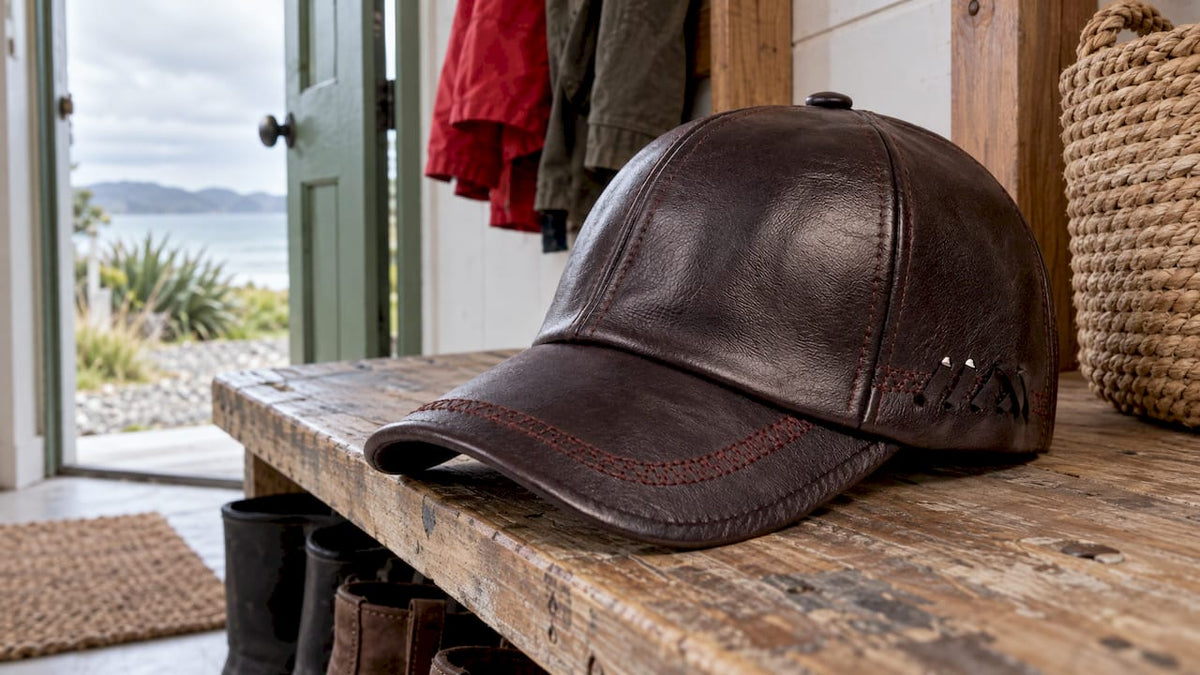
Patina is the slow darkening, softening and light sheen that real leather picks up from wear. On a leather hat it shows first where your hands, skin and the sun touch it most: the brim, the front panel and the crown. It is not damage and it is not dirt. With regular wear and simple care, it is the reason a leather hat looks better in year two than on day one.
This guide covers what patina is, how long it takes, which leathers show it, how black leather behaves, what to do (and skip) while it develops, and how to tell natural ageing from real wear and tear.
TL;DR
- Patina is the gradual change in colour, sheen and feel that leather gets from handling, light, air and skin oils. It is a sign the leather is being worn in, not worn out.
- Expect early changes within a few months of regular wear and a deeper look over a few years. The pace depends on how often you wear the hat and where.
- Full-grain and vegetable-tanned leathers show patina most clearly. Black leather changes more subtly, mostly in sheen.
- Keep it simple: wipe with a soft cloth, condition lightly once or twice a year, dry away from heat, store out of direct sun.
- Avoid harsh cleaners, heaters and soaking. Those cause damage that no patina will cover.
Table of Contents
- What patina on a leather hat actually is
- How a leather hat develops patina
- Which leathers develop patina (and what about black?)
- Care that helps patina develop
- Patina or damage? How to tell the difference
- Choosing a leather hat that will age well
- Our perspective on leather hat patina
- Find a leather hat to wear in
- FAQ
- Sources
What patina on a leather hat actually is
Patina is the gradual change in a leather’s colour, sheen, texture and overall character. Coach describes it as a warmer, richer, worn-in look shaped by sunlight, air, handling and wear, and says plainly that it is not damage or dirtiness. A New Zealand leather supplier, Zando, makes the same point from a local angle: no two patinas match, because each one forms through the way that particular piece is used.
On a hat, that plays out in specific ways:
- The brim darkens first. It is the part you grab to put the hat on and adjust it.
- The band area gains sheen. Skin contact and warmth polish the leather over time.
- Fold lines and creases deepen in tone. Flexing at points of regular movement leaves a visible record.
- The whole surface softens. A new leather hat can feel stiff. A worn-in one moulds to your head.
Patina is also not something applied in a workshop. As Patina Leather Goods in New Zealand puts it, it is the slow record of a life lived with leather. That is why a hat you wear on the farm, the boat or the school run will not age like one worn only to the odd barbecue.
Is patina a sign of real leather?
It is a good sign, with a caveat. Leather that has its natural grain intact and a light finish tends to show patina clearly. Heavily coated or very uniform surfaces tend to wear differently: they hold their colour but may show scuffs or wear at the edges instead of a deepening glow. Tuscany Bags explains that full-grain leather is the top layer of the hide with its natural grain left unsanded, and that this is the grade that develops a true patina.
So a hat that stays almost unchanged is not necessarily fake. It may simply have a more protective finish. The product description is the place to look for the leather type and finish.
How a leather hat develops patina
Three things work together over time, according to Staghide’s leather guide: oxidation from light exposure, absorption of natural skin oils, and physical flexing of the fibres where the leather moves. A hat gets all three. It sits in daylight, it touches your forehead and hair, and the brim and crown are handled and flexed every time you put it on and take it off.

How long does it take?
There is no fixed timeline, and any source that promises one is giving an average. Staghide says visible patina typically begins within 3 to 6 months of regular wear, and that a noticeably rich, deep patina usually takes 2 to 5 years of consistent use. Coach gives its own ranges for handbags: subtle softening after weeks to months, colour deepening after 3 to 12 months in high-touch spots, and a settled look after 1 to 3 years, depending on use and the leather’s starting colour.
A hat is a high-touch item worn close to the skin, so treat those ranges as a rough guide. What speeds things up:
- Wearing it often. Frequency matters more than anything else.
- Outdoor exposure. More frequent use and exposure to the elements make leather goods develop patina faster.
- Light-coloured leather. Tan, natural and cognac shades show change more than dark ones.
- Skin contact and handling. Oils from your hands and forehead do part of the work.
What slows it down: rotating between several hats, storing the hat in a box most of the week, and heavy protective finishes.
A realistic first year
This is a general picture, not a promise. Your hat will follow its own path.
| Stage | What you may notice |
|---|---|
| First weeks | The leather softens slightly. The brim and band show faint handling marks. |
| Months 3 to 6 | Early darkening where hands and skin touch. A light sheen starts on high-contact areas. |
| Months 6 to 12 | Clearer tonal differences between the brim, band and crown. Creases settle in. |
| Years 2 to 5 | A deeper, more even, burnished look, as the leather settles into its own character. |
Which leathers develop patina (and what about black?)
Leather type decides how dramatic your patina will be. Carl Friedrik notes that leather type, tanning, use and climate all play a part, which is why the result is hard to predict.
Full-grain and vegetable-tanned leather
Vegetable-tanned full-grain leather shows the most visible patina. Tascony explains that the organic tanning process and the absorbent nature of this leather are why. New Zealand leather maker Lapco for Leather notes that vegetable-tanned leather grows softer and darker with use, and that it can last a very long time if cared for.
The typical path: a pale, warm tan becomes a deeper honey, then a rich brown with a burnished look in the places you touch most.
Other finishes
Leathers with a more uniform colour, such as chrome-tanned or lightly coated types, keep their colour more evenly. They still soften and take on character through wear, but the change is quieter. For a hat, that can be a plus: you get a consistent look that stays tidy while it softens with use. If you love the dramatic colour shift, choose a natural, lightly finished leather. If you prefer a steady colour, a coated finish suits you.
Can black leather develop a patina?
Yes. Tascony says black leather can develop a patina like other leathers, though it may be less noticeable than on lighter shades. In practice, black changes by softening in sheen rather than shifting colour dramatically. On some finishes, the black top coat can wear in places to show brown tones underneath, a look many people like on a worn-in cap.
If you want a black leather hat to age gracefully, wear it often, keep it conditioned lightly, and let the sheen build on the brim and band.
Care that helps patina develop
Patina forms best when leather is looked after simply. You do not need a shelf of products. You need a routine you will actually follow.
Everyday habits
- Pick it up by the crown, not just the front. Squeezing or pinching the front panel repeatedly creates creases in the wrong places and can deform the shape.
- Wipe it down. Use a soft, dry or barely damp cloth for dust. Light scratches are part of the character.
- Keep perfume and hairspray away. Alcohol and aerosols can strip or mark leather. Put your hat on after styling your hair, not before.
- Store it out of direct sun. Toprank recommends avoiding prolonged sun exposure, soaking and harsh chemicals. Sun builds patina, but hours on a car dashboard fades and dries leather unevenly.
- Let it breathe. Hang it on a hook or rest it crown-down on a shelf. Avoid sealed plastic bags.
Conditioning: how often and how much
Condition lightly. Patina Leather Goods suggests a good beeswax or neatsfoot conditioner once or twice a year, or more if the leather starts to feel dry or stiff. Staghide recommends a thin, regular application every 3 to 6 months, and explains that conditioning feeds the hide the same oils body contact would supply over time, so it speeds natural patina without faking it.
A simple method:
- Brush or wipe off dust first.
- Test the conditioner on a hidden spot, such as the inside of the sweatband edge, and wait for it to dry. Conditioner often darkens leather a shade.
- Apply a very thin layer with a soft cloth, in small circles.
- Leave it to absorb, then buff gently with a clean cloth.
- Let the hat rest overnight before wearing it.
More is not better. A thick layer can leave the leather tacky and attract dust.
When the hat gets wet
New Zealand weather makes this a when, not an if. Blot off the excess water and let the hat dry at room temperature, away from heat, as Toprank advises. Stuff the crown loosely with paper or a cloth to hold its shape. Never use a heater, hair dryer or sunny windowsill.
If you wear your hat in the rain often, read our guide to waterproofing a leather hat with beeswax or spray. Waterproofing products can darken leather, so it helps to know that before you apply one. For a side-by-side look at how each material copes with Kiwi weather, see leather hat vs oilskin hat.
Cleaning without stripping the character
Patina and cleaning are not enemies, but the method matters. Our guide on cleaning a leather hat by its finish explains how to match the method to the leather and when to stop. In short: start with the gentlest method, and if three light passes do not lift a mark, stop and reassess rather than scrubbing harder.
For a wider routine covering all your hats, our hat care checklist covers cleaning, drying and storage. If you live somewhere warm and damp, our humid climate hat care tips help keep leather fresh and mould-free.
Patina or damage? How to tell the difference
Not every change is patina. Natural ageing looks even, warm and gradual. Damage looks sudden, patchy or rough. Here is a practical way to read your hat.
| Looks like patina | Looks like damage |
|---|---|
| Gradual darkening on the brim and band | A sharp, pale or dark patch with a clear edge (often a water mark or spill) |
| Soft sheen where skin and hands touch | A dull, chalky or cracked surface |
| Fine scratches that blend into the surface | Deep gouges or peeling top layer |
| Creases that soften over time | Stiff, brittle areas that crack when flexed |
| Colour that deepens evenly | Patchy fading from long, uneven sun exposure |
Common causes of damage rather than natural ageing include:
- Heat. Drying near a heater, or leaving the hat in a hot car, can leave leather stiff and brittle.
- Soaking, then fast drying. This can leave water rings and a hard feel.
- Harsh chemicals. Household cleaners, alcohol wipes and solvents can strip colour and finish.
- Too much product. Heavy layers of conditioner or wax can leave the surface sticky or blotchy.
- Crushing. Sitting on a hat or jamming it in a bag bends the structure and leaves creases that do not look like natural flex lines.
- Mould. In humid storage, spots can appear on leather and the lining. That is a care issue, not patina.
Most of these are avoidable with the habits above. If a mark appears, resist the urge to scrub. Let the hat dry naturally, then use a light touch.
Can you make a worn hat look newer?
You can freshen it without erasing its history. Dust it with a soft cloth, wipe lightly with a barely damp cloth, let it dry naturally, then condition thinly. Hand-warming and buffing will bring up the sheen. Accept light scratches as part of the look. Patina is not something to strip away; trying to return a worn-in hat to factory-new usually means harsh products, and that is where damage happens.
Choosing a leather hat that will age well
If you are picking a hat with patina in mind, think about three things.
1. Colour. Tan and brown shades show the biggest visible change. Black and very dark shades age subtly and keep a sharper look.
2. Style and how you wear it. A cap you wear daily will build patina faster than a dress hat kept for occasions. A baseball cap, a bucket hat or a newsboy cap sees constant handling at the peak and brim, which is where patina starts.
3. Climate and lifestyle. If you are outdoors a lot, sun and weather will speed the change. If you want a slower, more even result, rotate hats and store them away from direct light.

At Urban Caps we stock leather caps and hats in a range of shapes, so you can pick the style that suits how you will wear it. Read the product description for the leather type and finish, and use the care steps above from the first week.
Our perspective on leather hat patina
We are a New Zealand owned and operated hat store, and we see leather hats as the ones people keep longest. A leather cap or bucket hat is something you wear in, not something you wear out.
Our view is simple. Patina is part of what you are buying. A leather hat that softens, darkens and picks up character from your own habits becomes yours in a way a factory-fresh piece cannot. That suits the way Kiwis wear hats: outdoors, in changing weather, day after day.
So we encourage you to wear it, not shelve it. Use a gentle routine: a soft cloth, light conditioning, dry it away from heat, store it out of the sun. Our care guides exist so that your hat ages on your terms.
Choose the shape you will reach for every day. Frequent wear is what builds a good patina, and the right style is the one that is on your head.
Urban
Find a leather hat to wear in
If you are ready to start your own patina, browse our leather caps and hats. Popular starting points include the leather baseball cap, the leather bucket hat and the leather painter cap. We are proudly NZ owned and operated, with free shipping on all orders within NZ.

If you prefer a different shape, our newsboy caps and cheesecutter caps are also worth a look.
FAQ
Is patina real leather?
Patina is a natural change that happens to real leather, so seeing it is a good sign. It shows best on full-grain and vegetable-tanned leather, whose natural surface is left intact. Heavily coated leather ages more quietly, so a hat that changes little is not necessarily fake. Check the product description for the leather type and finish.
Can black leather develop a patina?
Yes, but the change is subtler than on tan or brown leather. Black tends to soften in sheen rather than shift colour, and on some finishes the top coat wears at the edges to show brown underneath. Frequent wear and light conditioning help the sheen develop.
How do I care for my leather hat?
Wipe it with a soft cloth, keep perfume and hairspray away, and store it out of direct sun. Condition it thinly once or twice a year, or sooner if it feels dry. If it gets wet, blot it and dry it at room temperature, away from heat. Our hat care checklist has the full routine.
How do I make a hat look new again?
Dust it, wipe it gently with a barely damp cloth, let it dry naturally, then apply a thin layer of conditioner and buff. This restores softness and sheen without stripping the patina. Avoid harsh cleaners, which can strip colour and finish. If a mark does not lift after a few gentle passes, stop rather than scrub.
How long does a leather hat take to develop a patina?
Early changes typically show within about 3 to 6 months of regular wear, and a deep, rich look usually takes a few years, according to Staghide. The pace depends on the leather, the colour and how often you wear the hat.
Sources
- What Is ‘Leather Patina’? | Coach
- Understanding Leather Patina | Zando New Zealand
- What is Patina? | Patina Leather Goods
- Leather Grades Explained | Tuscany Bags
- How Leather Develops a Patina | Staghide
- What is Leather Patina? The Complete Guide | Popov Leather
- What Is Leather Patina? | Carl Friedrik
- What Is Leather Patina and How Does it Develop? | Tascony
- FAQ’S & CARE | Lapco for Leather
- Leather Patina: How Veg Tan Leather Ages | Toprank Leather

Leave a comment
This site is protected by hCaptcha and the hCaptcha Privacy Policy and Terms of Service apply.